Who Is Satoshi Nakamoto? The Unsolved Mystery Behind Bitcoin

Satoshi Nakamoto is the pseudonym used by the person or group that created Bitcoin, wrote its original whitepaper, and deployed the first version of the software in 2009. Despite being responsible for inventing a technology now worth hundreds of billions of dollars, Satoshi's true identity remains unknown.
This is the most enduring mystery in modern finance. And after more than sixteen years, we still do not have a definitive answer.
What We Know for Certain?
On October 31, 2008, a message appeared on a cryptography mailing list. It contained a link to a nine page document titled "Bitcoin: A Peer to Peer Electronic Cash System." The author was listed as Satoshi Nakamoto.
The paper proposed a system for electronic transactions that did not require trust in a third party. It solved the double spending problem, a technical challenge that had stumped computer scientists for decades, by using a distributed ledger maintained through proof of work.
On January 3, 2009, Satoshi mined the first Bitcoin block, known as the Genesis Block. Embedded in the block's data was a headline from The Times of London: "Chancellor on brink of second bailout for banks." Whether this was a political statement or simply a timestamp, it has become one of the most quoted lines in crypto history.
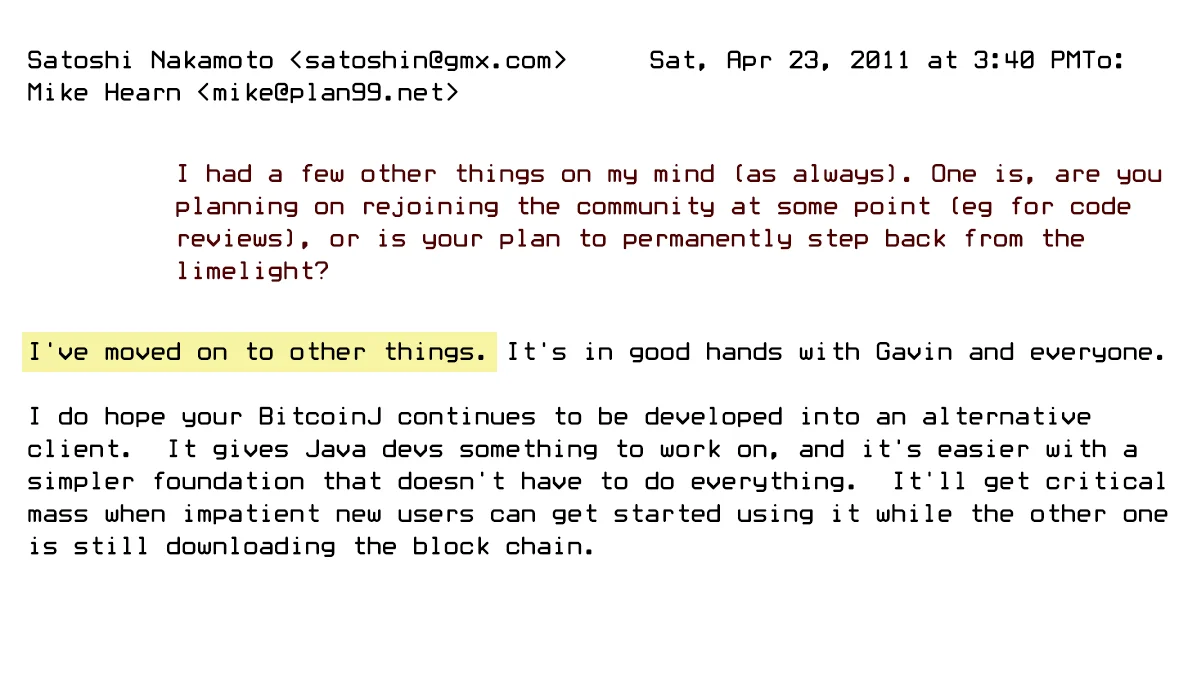
Over the next two years, Satoshi remained active. They communicated through forums and emails, coordinated with early developers like Hal Finney and Gavin Andresen, and continued refining the Bitcoin code. Then, in mid 2010, Satoshi began stepping back. By April 2011, they sent a final known email to a developer, writing: "I've moved on to other things."
Satoshi Nakamoto was never heard from again.
The Satoshi Fortune
The wallets associated with Satoshi are estimated to contain roughly 1.1 million BTC. At current prices, that stash is worth approximately $70 billion. None of these coins have ever moved. Not a single satoshi has been spent, transferred, or sold in over fifteen years.
This is significant for two reasons. First, it suggests that Satoshi, if still alive, has extraordinary discipline or has lost access to the keys. Second, it means that whoever Satoshi is, they are sitting on one of the largest fortunes on Earth and choosing to do nothing with it.
The Leading Candidates
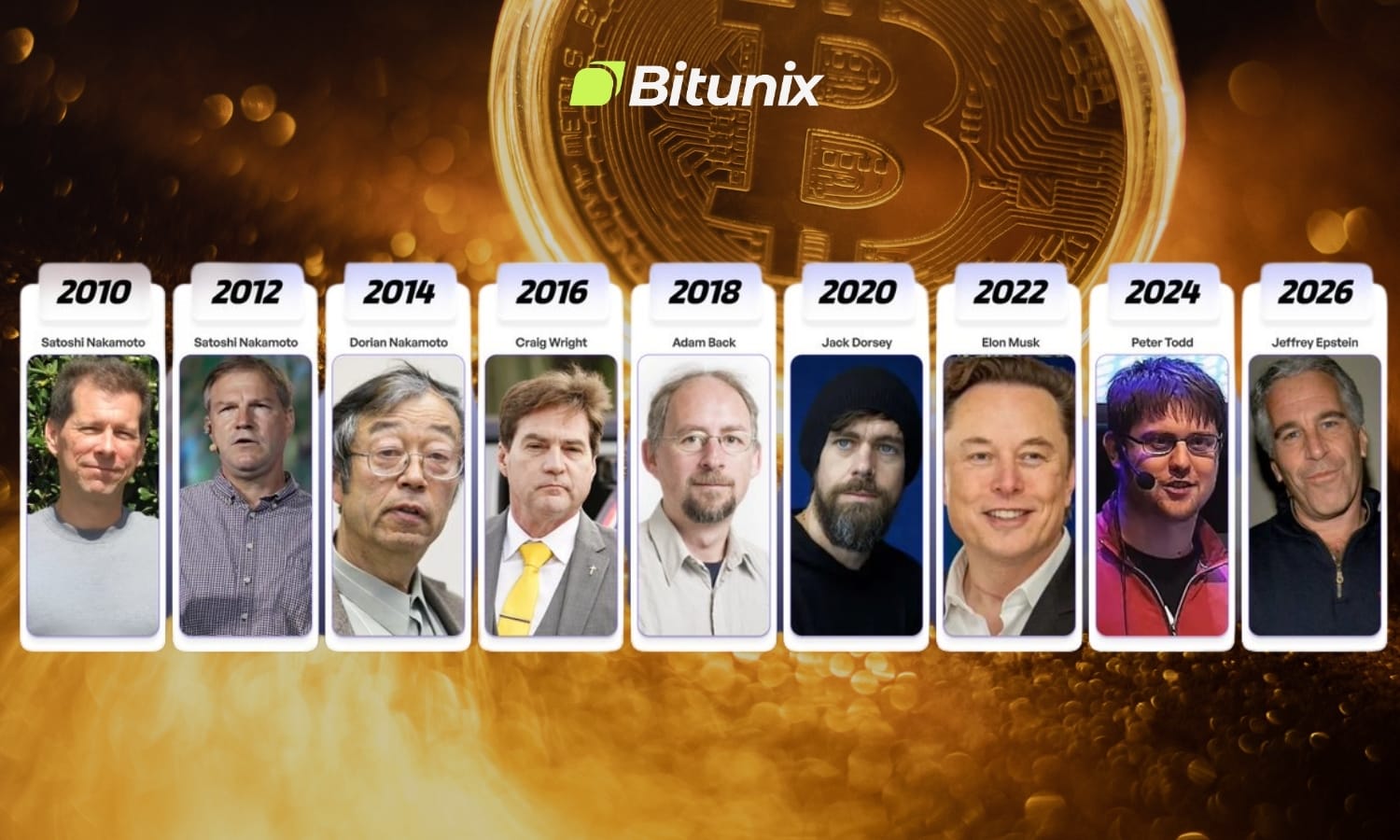
Numerous individuals have been proposed as the real Satoshi over the years. None have been confirmed.
Hal Finney was a renowned cryptographer and the recipient of the very first Bitcoin transaction. He lived near a man named Dorian Nakamoto (more on him shortly) in Temple City, California. Finney was deeply involved in Bitcoin's early development and possessed the technical skill to build the system. He denied being Satoshi and passed away in 2014 from ALS. His body is cryogenically preserved at the Alcor Life Extension Foundation.
Nick Szabo is a computer scientist who created "bit gold," a precursor to Bitcoin that shared many of its core principles. Szabo's writings from the late 1990s and early 2000s closely mirror concepts in the Bitcoin whitepaper. Linguistic analysis has noted similarities between Szabo's writing style and Satoshi's. Szabo has repeatedly denied being Satoshi.
Adam Back is the inventor of Hashcash, the proof of work system cited in the Bitcoin whitepaper. He is one of only two people referenced by Satoshi in the paper. Back is currently the CEO of Blockstream, a major Bitcoin development company. He denies being Satoshi, though speculation persists due to the deep technical overlap between his work and Bitcoin's architecture.
Wei Dai created b money, another decentralized currency concept referenced in the Bitcoin whitepaper. Dai's work on the cypherpunk mailing list laid foundational groundwork for what Bitcoin would become. He has stayed largely out of the spotlight and has neither claimed nor been seriously accused of being Satoshi.
Dorian Nakamoto was identified by Newsweek in a 2014 cover story as the real Satoshi based on his name, technical background, and proximity to Hal Finney. Dorian, a retired engineer living in California, vehemently denied any involvement. The Bitcoin community largely dismissed the claim, and Dorian later received donations from sympathizers.
Craig Wright is the most controversial figure in this discussion. The Australian computer scientist publicly claimed in 2016 to be Satoshi Nakamoto. He presented what he said was cryptographic proof, but the evidence was quickly debunked by the wider community. In 2024, a UK judge ruled definitively that Craig Wright is not Satoshi Nakamoto, stating that Wright had fabricated evidence and lied extensively in court. Despite the ruling, Wright has continued to make claims.
Why Satoshi's Anonymity Matters?
The mystery of Satoshi's identity is not just a fascinating puzzle. It is foundational to Bitcoin's design philosophy.
Bitcoin was built to operate without leaders, spokespeople, or figureheads. If Satoshi had remained public, they would have become a target for governments, lawsuits, and media pressure. Their opinions would carry outsized weight in protocol debates, effectively making Bitcoin a centralized project in practice.
By disappearing, Satoshi ensured that Bitcoin belongs to no one. There is no CEO to subpoena, no founder to pressure, and no single point of failure in the network's governance.
This is also why the unmoved coins matter. If Satoshi ever sold their stack, it would likely trigger market panic and raise fundamental questions about the project. Their silence and restraint, whether intentional or not, have become part of Bitcoin's mythology.
Will We Ever Find Out?
Probably not, and many argue that is for the best.
Blockchain analysis has mapped the wallets believed to belong to Satoshi. Writing pattern analysis has been run against dozens of candidates. Journalists have spent years following leads. Yet the mystery endures.
Some possibilities remain: Satoshi could be a single individual who has passed away, which would explain both the silence and the unmoved coins. They could be a small group that agreed to remain anonymous. Or they could still be alive, watching the system they built reshape global finance from the sidelines.
Whatever the truth is, the impact of their work speaks louder than any identity reveal could. Satoshi Nakamoto built a system that has run continuously for over sixteen years, processes billions of dollars in daily volume, and operates across every country on Earth, all without anyone knowing who is behind it.
That might be the point.
This article is for informational purposes only and does not constitute financial advice.