What Is a Bond? How Bonds Work and Why Their Prices Move
A bond is a loan with a price that moves opposite to interest rates. Learn how bonds work, why they made headlines in 2022 and 2026, and where the real risks hide.

This guide is for education only. It is not financial, investment, tax or legal advice, and nothing here is a recommendation to buy or sell anything. Past returns do not predict future results, and every investment can lose money. Do not base any decision on this article alone, and speak to a licensed professional about your own situation. Last updated: October 4, 2026.
In March 2023, Silicon Valley Bank collapsed within days. The assets that sank it were not exotic: according to the Federal Reserve's own review, securities, mostly US government and government backed bonds, made up 55% of its balance sheet at the end of 2022, and rising interest rates had cut their market value by an estimated $17.7 billion. A safe asset had quietly become a dangerous one, and the reason sits in a single idea that this guide explains: the price of a bond moves in the opposite direction to interest rates.
Six months earlier, the same lesson had hit the United Kingdom. In September 2022 the yield, the return a buyer earns at the current price, on 30 year UK government bonds called gilts jumped by 1.3 percentage points in only three trading days, and the Bank of England announced a temporary programme to buy up to £65 billion of them, according to its own analysis. Across the whole of that year, Bloomberg's US Aggregate Bond Index lost 13.01%, its worst year since the index began in 1976, and 2022 was the first year in that history in which both US stocks and US bonds fell.
It is happening again in slow motion. On September 24, 2026, the yield on the 30 year US Treasury bond reached 5.48%, its highest since 2004, and the 10 year yield touched 5.20%, Reuters reported, as investors worried that high energy costs and heavy government borrowing would keep inflation elevated. Since early March the 10 year yield has risen by about 1.25 percentage points, and Bloomberg's index of global government bonds has lost roughly 2.4% so far this year. Whether you own bonds, plan to, or only wonder why mortgage rates are near 7%, understanding bonds explains much of what is happening.
What Is a Bond in Simple Terms?
A bond is a loan you make to a government or a company for a set period. In return, the borrower pays you regular interest, called the coupon, and repays the original amount, called the principal or face value, on a fixed date known as maturity. Bonds are traded in markets, so their prices can change after they are issued.
Think of it as an IOU with a schedule. The borrower, called the issuer, gets cash today and agrees to a fixed timetable of regular interest payments and a final repayment. Governments issue bonds to fund spending, companies issue them to build factories or refinance debt, and investors buy them to receive that predictable stream of income. It is the same idea as a bank loan, except that the lender is you and the loan can be sold to someone else before it ends.
How Do Bonds Actually Work?
Every bond has three basic features. The face value is the amount repaid at the end, the coupon is the fixed annual interest expressed as a percentage of face value, and the maturity is the date the loan ends. A bond with a face value of $1,000 and a 5% coupon pays $50 a year, which US Treasury notes and bonds deliver in two installments of $25 every six months, and returns the $1,000 at maturity.
The important twist is that bonds keep trading after they are issued. The price is quoted as a percentage of face value, so a price of 100 means par, a price below 100 means a discount and a price above 100 means a premium. The coupon never changes, but the price does, and the yield is what a buyer actually earns at that price. TreasuryDirect explains this logic on its pricing page.
Why Do Bond Prices Fall When Interest Rates Rise?
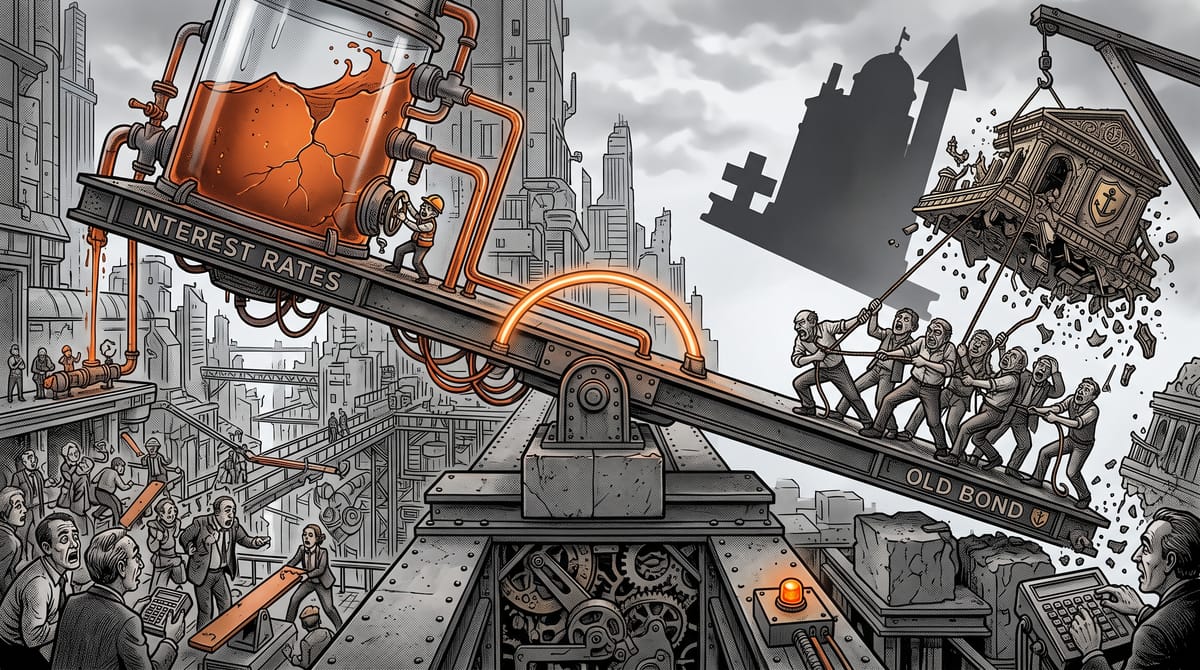
The easiest way to understand it is to compare an old bond with a new one. Imagine you own a 10 year bond that pays a 5% coupon. If market rates rise so that newly issued bonds pay 6%, nobody will pay full price for your 5% bond when a 6% bond is on sale, so its price must fall until its overall return matches the new bonds.
Take a $100 face value. The 5% coupon bond is worth exactly $100 when the market yield is 5%. If yields rise to 6%, its price falls to about $92.64, a drop of 7.4%, and if yields fall to 4%, its price rises to about $108.11. These figures come from the standard bond pricing formula with annual coupons and ten years remaining, and the same logic explains why falling rates help existing bonds.
Time matters too. A bond with 30 years left is far more sensitive than one with two, because its fixed coupon is stuck for much longer: with the same 5% coupon, a 30 year bond would fall to roughly 86 when yields rise to 6%, a drop of about 14%. That is why long term yields get so much attention, and why the 30 year Treasury sat at the center of the September 2026 selloff.
Does a falling price mean a real loss? Only if you sell. If you hold an individual bond to maturity and the issuer pays, you receive every coupon and the full face value, but you earned less than new buyers did while you waited, and inflation may have reduced what the money buys. A bond fund is different: it holds many bonds, never reaches a single maturity date, and its price keeps moving with yields.
What Are the Main Types of Bonds?
Bonds differ mainly by who borrows.
- Government bonds are issued by national governments. In the US, Treasury bills mature in a year or less, notes in 2 to 10 years and bonds in 20 or 30 years, while TIPS adjust their principal with inflation. The UK issues gilts, Germany issues bunds and Japan issues JGBs, and all of them can lose market value when yields rise.
- Corporate bonds are issued by companies. They are rated from safest to riskiest, with investment grade starting at BBB minus on the S&P scale and speculative grade, often called high yield or junk, starting at BB plus. A higher yield usually signals a higher risk of default.
- Municipal bonds are issued by US states, cities and local authorities, and their interest is often exempt from some taxes in the US.
Individuals in the US can buy Treasuries directly from TreasuryDirect from as little as $100, while most other bonds are bought through brokers or funds.
What Are the Real Risks of Investing in Bonds?
The first is interest rate risk: when yields rise, prices of existing bonds fall, and the longer the bond, the bigger the fall. Economists call government bond yields the risk free rate, but that phrase means the government is very unlikely to fail to pay, not that the price cannot drop, and the selloffs of 2022 and 2026 show the difference. Silicon Valley Bank was the extreme case of a holder that could not afford to wait.
The second is credit risk, the chance that the borrower fails to pay. Governments that borrow in their own currency rarely default in it, but companies do, which is why issuers are rated: investment grade bonds default rarely, while speculative grade bonds default much more often and pay higher yields to compensate. A high yield is therefore a payment for risk, not proof of a good deal.
The third is inflation risk. A bond's coupon and principal are fixed in money terms, so higher inflation reduces what they buy, which is why inflation protected bonds such as TIPS exist. Bonds also carry liquidity risk, since some are hard to sell quickly, and reinvestment risk, since falling yields lower the return on money that comes back to you.
How Do Bonds Compare to Stocks?
A bond makes you a lender, while a stock makes you a part owner. Lenders are paid before owners if a company fails, and bond payments are set in advance, which is why bonds have historically swung less than stocks. Over the very long run, the UBS Global Investment Returns Yearbook puts the return of US stocks at about 6.6% a year after inflation since 1900, against roughly 1.6% for US government bonds, a gap that rewards stock owners for accepting bigger swings.
But bonds do not always cushion stocks. In 2022 both fell together: the S&P 500 lost 18.11% including dividends and Bloomberg's US Aggregate Bond Index lost 13.01%. Bonds tend to help when stocks fall because of a growth scare, and they struggle when inflation and rising rates drag both down.
What Do Today's Bond Yields Tell Us?
On October 2, 2026, according to Treasury data, the US 3 month yield was 4.19%, the 2 year 4.83%, the 10 year 5.28% and the 30 year 5.63%. The 10 year yield was 3.97% at the end of February, just before the war in the Middle East began, and 1.52% at the end of 2021. An investor who locked in a 10 year Treasury at the end of 2021 therefore earns far less than a new buyer today, and that older bond trades at a deep discount.
Yields have swung widely over time: the 10 year reached 15.84% in September 1981 and fell to a record low of 0.52% in August 2020, so today's level is high compared with recent years but not compared with the longer history.
Whether this is an opportunity is exactly where investors disagree. Supporters note that a 5% yield is a much larger cushion against price falls than the 1.5% of 2021, and that the 10 year yield now exceeds US inflation of 3.4% by about 1.9 percentage points, a simple measure of the real yield. Skeptics point out that yields have kept rising for months, that Reuters reported investors eyeing 6% as the next pain threshold, and that falling prices can continue before they stop. This guide does not say which side is right, because nobody can know in advance.
Before You Buy a Bond: Questions to Ask First
A few questions help before you consider any bond, and they protect against the most common misunderstandings.
- Who is the issuer, and how is it rated? A government and a speculative company are very different borrowers.
- When does it mature, and when do you need the money? If you may need the cash before maturity, you may have to sell at a loss.
- Is it a single bond or a bond fund? A fund has no maturity date and its price moves every day.
- What are the yield and the price? Compare the yield, not only the coupon, and check whether you pay a premium or buy at a discount.
- What does it cost? Fees and spreads reduce income, especially on small purchases.
- Who is selling it, and why? Guaranteed high returns, unregulated mini bonds and crypto products that borrow the language of bonds are classic traps.
The Bottom Line
A bond is a loan with a schedule, and its price is a living number that moves opposite to interest rates. That single fact explains why a bank holding safe looking bonds failed in 2023, why the broad bond market had its worst year on record in 2022, and why September 2026 saw long term yields reach levels last seen in 2004. Bonds can offer steadier income than stocks, but steadier does not mean safe from loss, and the issuer, the maturity and the price decide the outcome.
Bonds are one card in the bigger map we drew in our guide to types of investments. Next up: stocks, the other side of the ladder, where you stop being a lender and become an owner. Until then, remember that understanding how an instrument can lose money is the first step toward deciding whether it has any place in your plans.
This article is educational and not financial advice. Do not rely on it to make investment decisions.
Frequently Asked Questions
- What is the difference between a bond and a stock?
A bond is a loan to a government or company that pays interest and returns your principal at maturity, while a stock is a share of ownership with no promised payments. Lenders are paid before owners if a company fails.
- Can you lose money on a bond?
Yes. The price can fall if interest rates rise, and the issuer can fail to pay. Holding an individual bond to maturity and being paid in full avoids a price loss, but not the effect of inflation.
- What is the difference between a Treasury bill, note and bond?
They differ by maturity: bills mature in a year or less, notes in 2 to 10 years and bonds in 20 or 30 years. All are issued by the US government, and notes and bonds pay interest every six months.
- How often do bonds pay interest?
It depends on the bond. US Treasury notes and bonds pay every six months, many US corporate bonds pay twice a year, and some bonds in other countries pay once a year.
- Why are bonds considered safer than stocks?
Their payments are fixed in advance, lenders rank ahead of owners if a company fails, and their prices have historically swung less. Safer does not mean safe: 2022 showed that both can fall in the same year.