CEX vs DEX: How to Choose the Right Crypto Exchange in 2026?


Centralized and decentralized exchanges serve fundamentally different purposes. Here's what actually matters when picking between them — with real trade-offs, not just marketing fluff.
If you're buying or trading crypto, you're going to interact with an exchange. The question is: do you want a centralized exchange (CEX) that works like a traditional brokerage, or a decentralized exchange (DEX) that lets you trade directly from your wallet with no middleman?
This decision isn't just about preference. It affects your security, privacy, available assets, trading costs, and how much control you have over your own money.
Centralized Exchanges: What They Actually Do
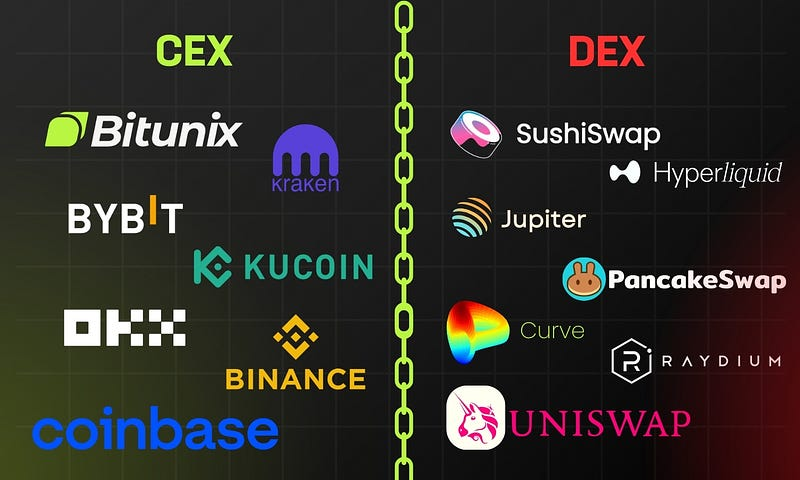
A CEX is a company that operates a trading platform. Binance, Coinbase, Kraken, Bitunix, OKX — these are all centralized exchanges. You create an account, complete identity verification (KYC), deposit your funds, and trade through the platform's order book.
When you hold crypto on a CEX, the exchange controls the private keys. Your balance is essentially a database entry on their servers. You trust them to keep your funds safe and solvent.
What works well:
CEXes handle the complexity for you. Fiat on-ramps (buying crypto with dollars, euros, or lira), deep liquidity for major trading pairs, and fast execution speeds make them practical for everyday trading. Platforms like Bitunix offer futures trading, leveraged positions, and sleek mobile interfaces that make the experience feel familiar even for first-timers.
Liquidity is a big deal. When you're trading BTC/USDT or ETH/USDT, a major CEX can fill large orders with minimal slippage. Try doing the same with a low-cap token on a DEX and you'll see a noticeable price impact.
What doesn't:
The phrase "not your keys, not your coins" exists for a reason. The FTX collapse in November 2022 wiped out billions in customer funds. The Bybit hack in February 2025 cost roughly $1.4 billion in Ethereum. These aren't hypothetical risks — they're recent history.
KYC requirements also mean surrendering personal data. For users in jurisdictions with aggressive surveillance or unstable financial systems, this isn't a minor concern.
And CEXes can freeze your account. Regulatory pressure, compliance issues, or even a flagged transaction can lock you out of your own funds with no recourse.
Decentralized Exchanges: Trading Without a Middleman
A DEX runs on smart contracts deployed on a blockchain. Uniswap on Ethereum, Raydium on Solana, PancakeSwap on BNB Chain — these platforms let you swap tokens directly from your wallet. No account creation, no KYC, no custody risk.
Most DEXes use an automated market maker (AMM) model instead of traditional order books. Liquidity providers deposit token pairs into pools, and traders swap against these pools. Prices are determined algorithmically based on the ratio of tokens in the pool.
What works well:
You stay in control of your assets. Your wallet connects to the DEX, approves a transaction, and the swap happens on-chain. Nobody can freeze your funds or deny you access.
Privacy is another advantage. There's no sign-up process, no identity documents, no data to leak in a breach. If you have a crypto wallet and some tokens, you can trade.
DEXes also tend to list tokens much earlier than CEXes. If you're researching new projects or smaller cap altcoins, a DEX is often the only place to find them initially.
What doesn't:
Usability is still rough. Managing gas fees, understanding slippage settings, avoiding scam tokens — this requires knowledge that most newcomers don't have. One wrong transaction approval on a malicious contract can drain your wallet.
Liquidity for smaller pairs can be thin, leading to significant slippage on larger trades. And while AMMs work well for simple swaps, they don't support advanced order types like limit orders or stop losses natively (though some DEX aggregators are adding these features).
Smart contract risk is real. If there's a bug in the protocol code, funds can be exploited. The Wormhole bridge hack ($320 million in 2022) showed how quickly things can go wrong in DeFi.
Head-to-Head Comparison
Security: CEXes have institutional security teams but represent single points of failure. DEXes eliminate custodial risk but expose you to smart contract vulnerabilities. Neither is perfectly safe — the risk profile is just different.
Speed: CEXes process orders off-chain in milliseconds. DEXes depend on blockchain confirmation times — sub-second on Solana, 12+ seconds on Ethereum, and can spike during congestion.
Costs: CEX fees are typically 0.1-0.5% per trade plus withdrawal fees. DEX costs include swap fees (usually 0.3%) plus gas fees, which vary wildly. On Ethereum, a swap during peak hours can cost $20-50 in gas alone. On Solana or BNB Chain, it's usually under $0.10.
Asset availability: CEXes list hundreds of vetted tokens. DEXes list anything anyone deploys — which means access to thousands of tokens, but also thousands of scams and rug pulls.
Privacy: CEXes require full identity verification. DEXes require only a wallet address.
The Real Answer: Most Traders Use Both
The CEX vs DEX debate often gets framed as either-or, but in practice, experienced traders use both depending on the situation.
CEXes work best for fiat on/off ramps, high-volume trading, futures and margin positions, and trading major pairs with deep liquidity. If you're converting TRY or USD to crypto, a CEX is the most practical path.
DEXes work best for accessing new tokens early, maintaining privacy, participating in DeFi (liquidity provision, yield farming), and avoiding counterparty risk.
A practical workflow: buy crypto on a CEX, transfer to a self-custody wallet, and use DEXes for DeFi activities or early-stage token swaps. This balances convenience with control.
What to Watch in 2026
The line between CEX and DEX is blurring. Hybrid models are emerging — centralized platforms adding non-custodial features, and DEXes improving their interfaces and adding order book functionality.
Regulatory pressure continues to shape the landscape. The EU's MiCA framework and evolving U.S. crypto legislation are pushing CEXes toward stricter compliance, while some DEXes face scrutiny over facilitating unregistered token sales.
On the DEX side, aggregators like Jupiter (Solana) and 1inch (multi-chain) now route trades across multiple liquidity sources, significantly reducing slippage. Cross-chain bridges are also maturing, though the security record remains mixed.
The bottom line: your choice between CEX and DEX should depend on what you're trying to do, not tribal loyalty to one model. Both have clear advantages and real risks.
Disclaimer: This article is for educational purposes only. Cryptocurrency trading involves significant risk. Always do your own research before making financial decisions.